Date:2026-04-09 Click:
As the first modern industry college in China focused on the VR field, the Virtual Reality (VR) Modern Industry College has, since its establishment in September 2020, consistently aligned with the national strategy for industry-education integration and served Jiangxi’s industrial planning for virtual reality and electronic information. Over five years, the college has been approved as one of Jiangxi’s first key modern industry colleges, its virtual reality technology program has received an “A+” rating from Soft Science, and it has supplied 2,066 high-quality talents to the digital industry. This article is the third in a series of reports, focusing on how the college breaks new ground in building a new ecology of industry-education integration through three major mechanisms: “introducing enterprises to campus, physical integration, and mutual empowerment.”
The Challenge of Breaking New Ground: The Struggles of Emerging Industries
and the Difficulties of Industry-Education Collaboration
As a cutting-edge field of the digital economy, the VR industry is in a critical period of transitioning from technological breakthroughs to industry applications. Five departments, including the Ministry of Industry and Information Technology, have jointly issued the “Action Plan for the Integrated Development of Virtual Reality and Industry Applications” and the “Three-Year Action Plan for the Innovative Development of the Metaverse Industry,” aiming to accelerate industrial implementation. Jiangxi Province places great importance on the development of the VR industry. Since 2016, it has formulated a series of industrial policies and is fully committed to building a “Global VR High Ground.” Nanchang is home to the National Virtual Reality Innovation Center and is also the permanent host of the World VR Industry Conference.
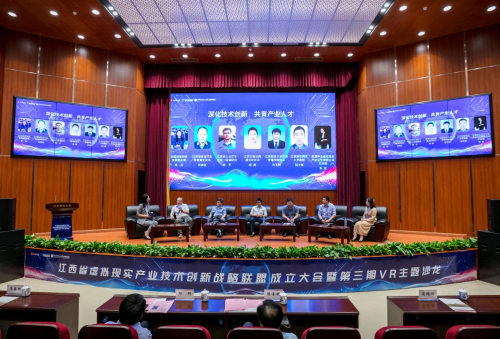
The emerging VR industry is characterized by interdisciplinary integration, the combination of industry, academia, and research, rapid technological iteration, and fast-changing demands. Meanwhile, new VR programs face issues such as underdeveloped curriculum systems, insufficient teaching resources, relatively weak faculty strength, and untimely updates to experimental facilities. The industrial landscape, where the scale of the VR industry is relatively small and VR companies are relatively weak, has kept university-enterprise cooperation at the level of “point-to-point” project collaborations for a long time, resulting in fragmented resources and loose relationships. There is a lack of physical collaborative organizations among various entities, faculty within the university lack industrial practical experience, industry demands are difficult to translate into educational standards in a timely manner, and enterprise resources are challenging to systematically integrate into teaching processes. How to consolidate scattered industrial resources, transform short-term project collaborations into long-term symbiotic ecosystems, and achieve deep integration and mutual empowerment when both industry and education are in their early stages of development is a contemporary challenge that VR programs, the VR industry, and all new programs and emerging industries must address.
Gathering Enterprises Through Alliances: From “Single-Point Cooperation”
to an “Industrial Ecosystem”
The first step in breaking new ground is to systematically gather resources across the entire chain using industrial alliances as a leverage point. In 2021, JUFE took the lead in establishing the Jiangxi Virtual Reality (VR) Industry Technology Innovation Strategic Alliance and serves as the chair unit, attracting 95 member units covering the entire chain of “government, industry, academia, research, application, and finance.” The alliance locates its secretariat on campus and, through the mechanism of “introducing the alliance to campus and integrating the college with the alliance,” regularly organizes activities such as technical salons, standard discussions, talent exchanges, and achievement exhibitions, attracting enterprises to deeply participate in college construction and talent cultivation.
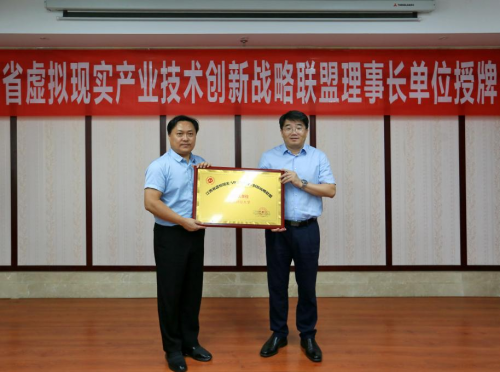
Using the alliance as a link, the college promoted the establishment of a college council with 48 member units, constructing a “co-construction, co-management, co-sharing” school-enterprise collaborative governance system. The government provides policies and special funds, leading enterprises import technology platforms and commercial projects, research institutes open their resources, and industry associations link demands. In recent years, the college has led the compilation of 3 industry white papers and participated in formulating 15 technical standards, solidifying the foundation of industry-education integration through institutional outputs.
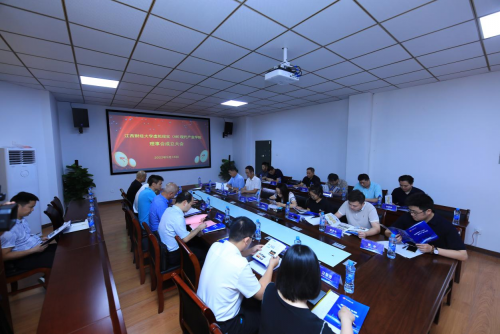
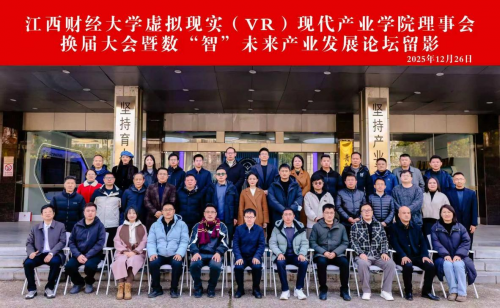
JUFE independently allocated the Fenglinyuan Campus, covering an area of over 200 acres, to the college. Building upon traditional teaching buildings and experimental training centers, new industry-education integration bases and innovation entrepreneurship workshops were established as collaborative education spaces integrating production, education, and research. Over 30 million RMB was invested to build 2 VR professional laboratories, 20 high-end computer rooms, and 9 studios. This strategy of “building nests to attract phoenixes” laid a solid foundation for creating a model industry-education integration park that aggregates all elements of “government, industry, academia, research, alliance, and park.”
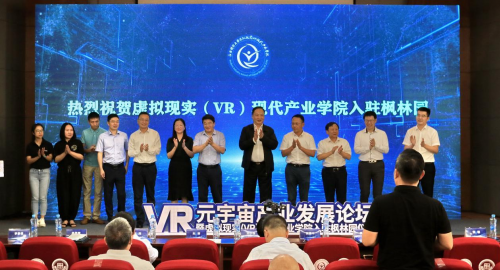
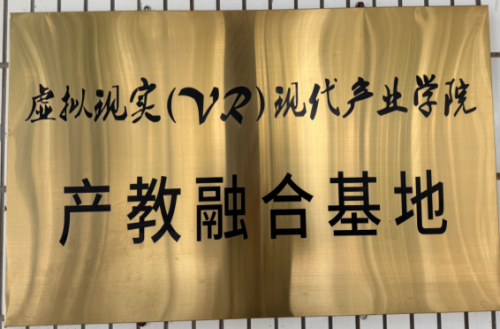
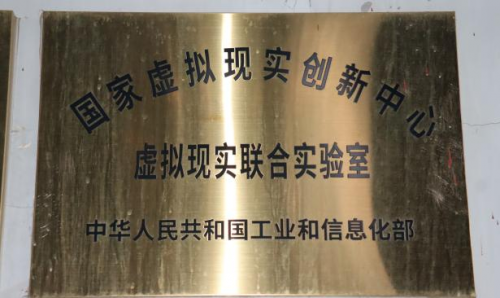
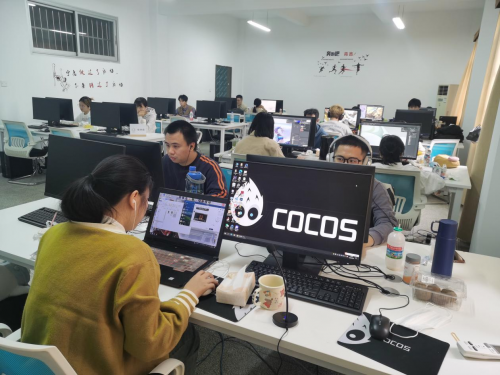
To effectively transform industrial resources into educational capacity, the university introduced the “JUFE Management Measures for Introducing Enterprises into Campus,” bringing in 8 high-quality enterprises to set up on-campus studios. These enterprises integrate new technologies, processes, and standards into teaching, transforming the studios into “on-campus industry-education integration bases” that combine corporate mentors, authentic R&D environments, cutting-edge technologies, and commercial projects. The on-campus studios have collectively invested over 15 million yuan in equipment and platforms and introduced more than 18 million yuan in commercial project funding. This allows students to participate in real project development on campus, accumulating 1-2 years of corporate work experience.
Enterprise-Enterprise-Research: From “University-Enterprise Cooperation”to “Ecological Symbiosis”
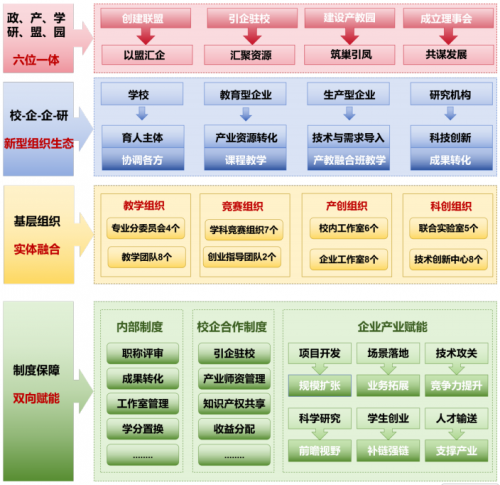
As industry-education integration deepens, the college has proposed and formed a new “University-Enterprise-Enterprise-Research” collaborative education ecosystem. JUFE serves as the educational main part and coordinates all parties, educational enterprises are responsible for transforming industrial resources and delivering course instruction, production enterprises introduce cutting-edge technologies and real demands into industry-education integration classes, and research institutions collaborate with universities and enterprises on technological innovation and achievement transformation. Each party fulfills its role, leveraging complementary strengths to fully integrate industrial resources, advanced technologies, and real-world needs into the educational process.
JUFE has signed collaborative education agreements with Nanchang Wei’ai Information Technology Co., Ltd., Xiamen Touch the Future Technology Co., Ltd., and Shenzhen Yida Digital Co., Ltd. It conducts substantive collaborative education and business cooperation with over 20 enterprises, including opening specialized classes, organizing internships and practical training, tackling technical challenges, and developing projects. Furthermore, it jointly cultivates technologically innovative talent with research institutions such as Nanchang Virtual Reality Research Institute Co., Ltd. (National Virtual Reality Innovation Center), Beijing University of Aeronautics and Astronautics Jiangxi Research Institute, and Jiangxi Qiushi Advanced Research Institute. All participating parties fully share resources, synchronize talent cultivation with corporate growth, and collectively empower the high-quality development of the VR industry.
Entity Implementation: From “Loose Alliance” to “Entity Collaboration”
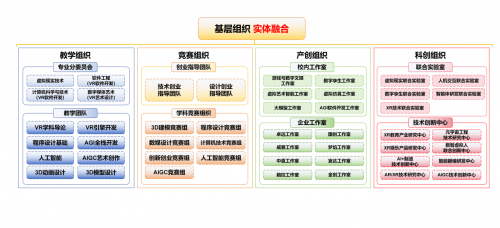
Focusing on the entire process of talent cultivation and industrial innovation, the college has top-down constructed a matrix of 48 grassroots collaborative organizations covering teaching development, technological innovation, industrial innovation, and concept verification.
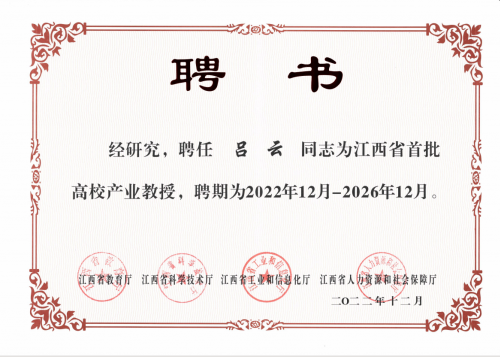
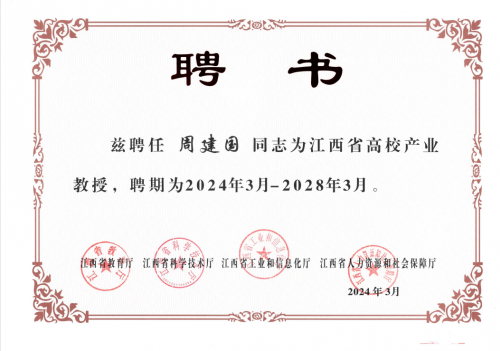
Four professional sub-committees and eight mixed school-enterprise teaching teams have embedded industry standards into the curriculum system. Enterprises and research institutions have contributed over 60 industry lecturers for teaching, among whom five were approved as Jiangxi Provincial Industry Professors and nine as Jiangxi Provincial Industry Mentors. Nearly 100 frontline engineers, corporate executives, and industry experts have deeply participated in talent cultivation, jointly developing 67 industry-education integration courses, co-authoring 18 textbooks and teaching materials, and transforming 167 enterprise project cases.
Seven discipline competition organizations and two entrepreneurship guidance teams cover competition coaching and startup incubation. Student teams have repeatedly achieved honors in high-level domestic and international discipline competitions, winning a total of 31 national awards in the three major competitions—including two National Special Awards in the “Grand Challenge” (only six in Jiangxi’s history), two National Gold Awards in the “Small Challenge,” and one National Gold Award in the “Internet+”—as well as 196 national awards in Ministry of Education whitelist events.
Six on-campus faculty-student studios and eight enterprise resident studios undertake tasks such as technological breakthroughs, product development, and project implementation, generating significant economic and social benefits. Five school-enterprise joint laboratories and eight technological innovation centers are deployed in cutting-edge fields like human-computer interaction, digital twins, and AIGC, resulting in 16 core technologies and 14 core products. Technological innovation leads educational teaching and feeds back into enterprise development.
From Breaking the Mold to Establishing a New Paradigm: A Replicable Path for Industry-Education Integration
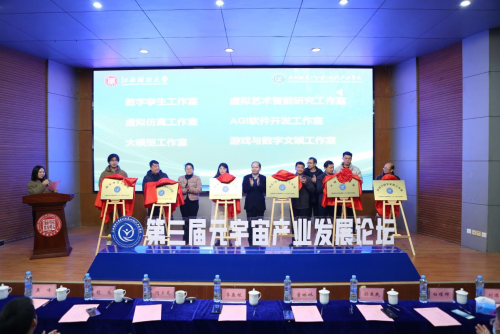
Reflecting on the five-year reform, VR College’s exploration has formed a clear practical path: leveraging alliances to pool resources and address breadth challenges; achieving symbiosis through resident programs to overcome depth difficulties; and building physical hubs to break through effectiveness bottlenecks.
The core of this path lies in whether diverse stakeholders can be truly brought together, whether resource transformation organizations can be genuinely established, and whether benefit-sharing mechanisms can be effectively put in place. Industry-education integration is not an “extra credit question” for education, but an essential path for the development of emerging industries; it is not a one-way contribution from enterprises, but a shared value investment by both schools and enterprises. This path of deep integration, which uses entity-based approaches to overcome fragmentation and replaces mere exchange with symbiosis, provides a replicable “Jufe Solution” for more higher education institutions.

Jiangxi University of Finance and Economics
Contact us: Office of International Cooperation and Exchange(OICE)
Address: No.168, East Shuanggang Road, Nanchang, Jiangxi Province, PR. China 330013