Date:2025-09-26 Click:
To actively serve the construction of JUFE's "Three Transformations", the team led by Associate Professor Wang Jing from the School of Software and Internet of Things Engineering has been deeply engaged in the frontier research of multi-objective optimization algorithms and recently achieved a series of important progress. From 2024 to 2025, the relevant innovative achievements were continuously published in international authoritative journals such as Expert Systems With Applications, Applied Soft Computing, and Information Sciences (INS). This marks that the team has realized multi-dimensional breakthroughs in improving the core efficiency of algorithms, providing a more efficient solution for complex engineering and scientific computing problems.
Achievement 1: Steady-State Mechanism Enhances Algorithm Efficiency and Balance The research titled "A stable-state multi-objective evolutionary algorithm based on decomposition", published in Expert Systems With Applications in 2024, proposes an innovative steady-state multi-objective evolutionary algorithm based on decomposition (MOEA/D-SS). By dynamically adjusting the number of replaced individuals in the neighborhood, this algorithm optimizes the matching relationship and significantly reduces the waste of computing resources. Meanwhile, it adaptively adjusts the neighborhood size according to the difficulty of sub-problems, enhancing the algorithm's adaptability in different optimization stages. MOEA/D-SS performs exceptionally well in handling problems with complex Pareto Fronts (PF), and its performance is significantly superior to that of several advanced comparison algorithms (such as MOEA/D-AGR and MOEA/D-AWA). It effectively balances the exploration and exploitation capabilities, providing strong application support for complex engineering optimization.
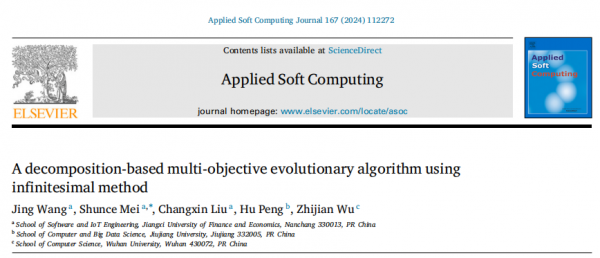
Achievement 2: Infinitesimal Method Optimizes Weight Vector Allocation Another study of the team, "A decomposition-based multi-objective evolutionary algorithm using infinitesimal method", was published in Applied Soft Computing in the same year, putting forward the MOEA/D-DKS algorithm. Drawing inspiration from the "infinitesimal method" in mathematics, this work improves the adjustment strategy of weight vectors by applying the "divide and conquer" idea. For multi-objective optimization problems with complex and irregular Pareto Front structures, MOEA/D-DKS realizes the dynamic and refined adjustment of weight vector distribution through global decomposition and feature analysis, thereby greatly improving the allocation efficiency of computing resources and the overall performance of the algorithm. In the rigorous verification covering 28 benchmark test problems, MOEA/D-DKS shows significant advantages in two key indicators: convergence and diversity. It provides a powerful new tool for dealing with complex optimization problems with irregular PF in the real world.
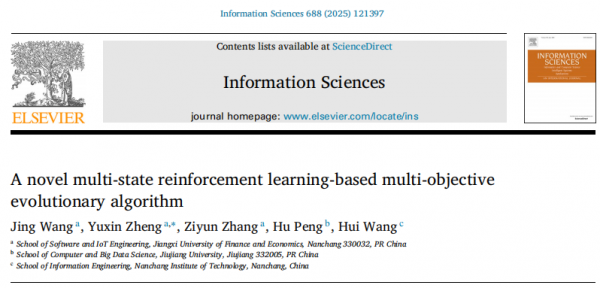
Achievement 3: Reinforcement Learning Empowers the Intellectualization of Evolutionary Algorithms The team's latest achievement, "A novel multi-state reinforcement learning-based multi-objective evolutionary algorithm", was published in Information Sciences in 2025. This research innovatively integrates the multi-state reinforcement learning (MRL) framework into the multi-objective evolutionary algorithm and proposes MRL-MOEA. The algorithm aims to overcome the core difficulty of balancing population diversity and convergence. Experiments have proved that on standard test sets such as DTLZ and WFG, especially in high-dimensional complex problems with 3 to 10 objectives, the performance of MRL-MOEA significantly surpasses that of existing advanced algorithms. This research not only provides an efficient and intelligent new approach for solving complex optimization problems but also successfully verifies the great potential of the integration of reinforcement learning and evolutionary algorithms.
The series of research achievements of Associate Professor Wang Jing's team, ranging from the steady-state mechanism, dynamic optimization of weight vectors to the intelligent integration of reinforcement learning, have formed a clear technological evolution path. They have achieved significant multi-dimensional improvements in the core efficiency of multi-objective optimization algorithms. These achievements not only have important theoretical value but also provide more efficient support for addressing complex optimization challenges in practical engineering and scientific computing, strongly contributing to the improvement of JUFE's scientific research capabilities and strategic transformation.
Expert Systems With Applications (ESWA), Applied Soft Computing (ASOC), and Information Sciences (INS) are internationally recognized authoritative journals in the fields of computer science and artificial intelligence. All of them are highly recommended by top international academic organizations such as ACM and IEEE and have long been important platforms for publishing high-level research results. In the current mainstream academic evaluation system, these three journals all belong to the first district (TOP journals, top 5%) of the computer science category (2024 data). Their JCR impact factors are 8.5 (ESWA), 8.7 (ASOC), and 8.1 (INS) respectively, and they all stably rank in the Q1 district (top 25%), enjoying extensive academic influence worldwide.

Jiangxi University of Finance and Economics
Contact us: Office of International Cooperation and Exchange(OICE)
Address: No.168, East Shuanggang Road, Nanchang, Jiangxi Province, PR. China 330013