Date:2025-04-18 Click:
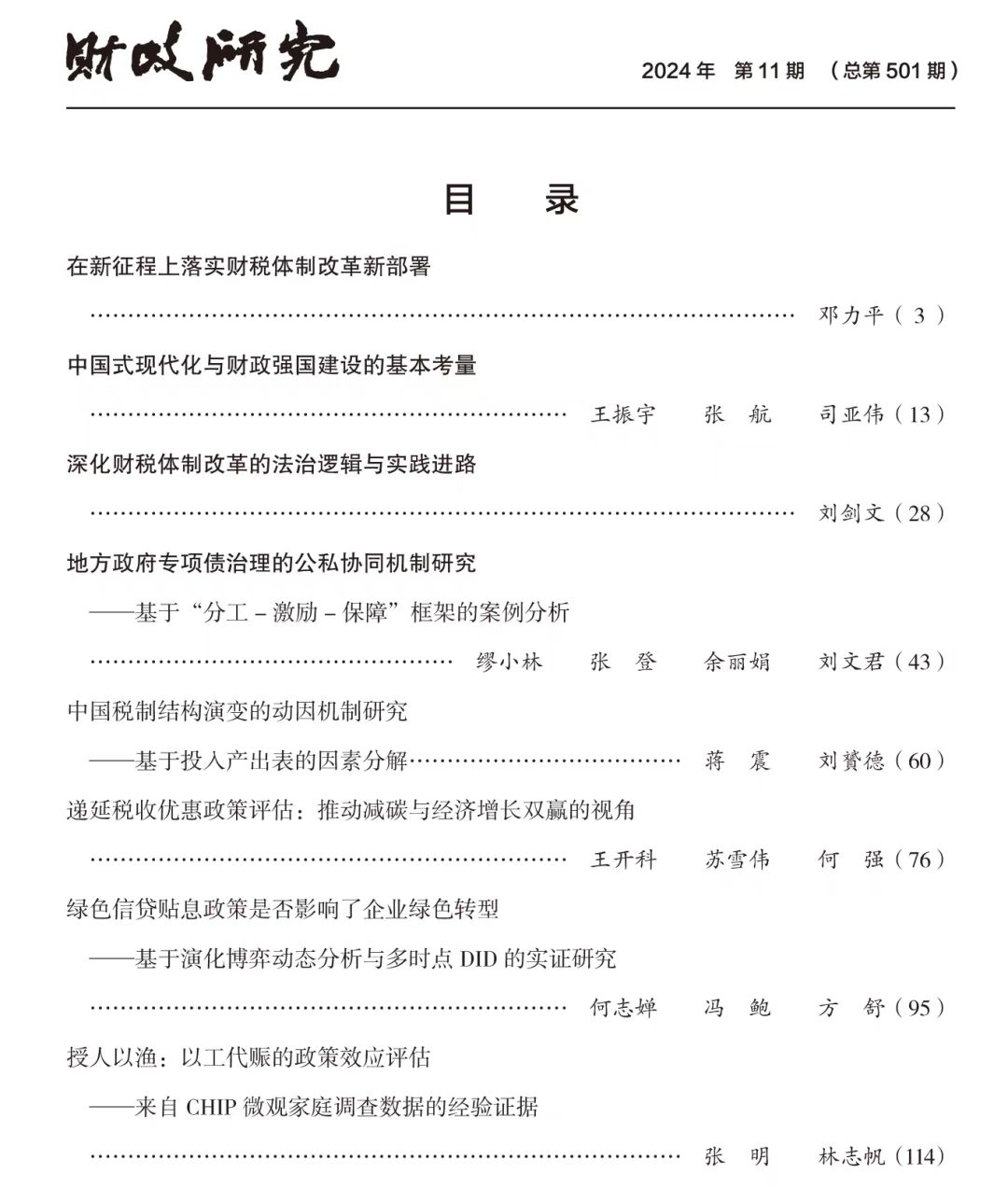
Recently, Professor Wang Kaike of the School of Statistics and Data Science, Su Xuewei, PhD candidate of the Zou Zhizhuang Economic Research Institute of Xiamen University, and He Qiang, researcher of the Institute of Statistical Science of the National Bureau of Statistics,published the paper "Evaluation of Deferred tax preferential Policies: Promoting the win-win perspective of carbon reduction and economic growth"in the authoritative Chinese A-journal "Fiscal Research", No. 11, 2024.
To promote the realization of the "carbon peaking and carbon neutrality goal" is a solemn commitment made by China as a responsible major country to the world. How to evaluate the effectiveness of carbon management in China in recent years is a topic of common concern in both theoretical and practical circles.For a long time, some Western countries have ignored the impact of global industrial layout, deliberately emphasized the total scale of China's carbon emissions and unreasonable carbon emission reduction responsibility, and underestimated the efforts and achievements made by China for the global carbon emission reduction cause.In this regard, the paper proposes to evaluate the effectiveness of carbon governance from the perspective of carbon emission intensity, and measure the synergistic effect between carbon reduction and growth through carbon emission per unit of output value.Based on this starting point, we take the accelerated depreciation policy of fixed assets as an example to explore the positive impact of deferred tax incentives on promoting carbon reduction and economic growth.
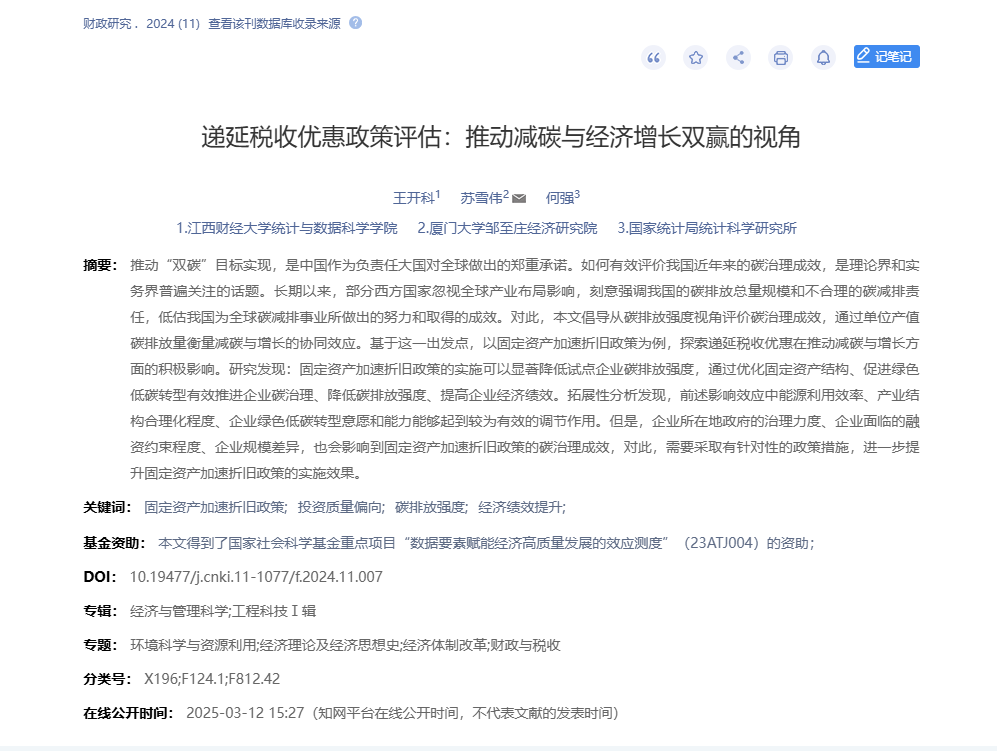
Since the policy of accelerated depreciation of fixed assets was piloted in some industries and fields in 2014, its implementation scope has been continuously expanding. By 2019, it had been extended to all manufacturing enterprises across the country. It is one of the tax preferential policies with a relatively wide implementation scope and comprehensive implementation in the industrial field at present. Considering that some carbon reduction measures may require enterprises to make large upfront investments, which will increase the cost of enterprises in the short term and exert certain pressure on their economic benefits, and thus affect their investment decision-making behavior, it is necessary to further verify whether the policy can achieve a win-win situation of carbon reduction and economic growth. In this regard, this article attempts to place the issues of carbon reduction and growth in a unified theoretical framework to explore the impact of the policy of accelerated depreciation of fixed assets on the carbon governance of industrial enterprises. It should be emphasized that this article has improved the measurement method of carbon emissions at the enterprise level by introducing an adjustment coefficient, which has better solved the problem of heterogeneity of carbon emissions among enterprises.
"Fiscal Research" (monthly) is a national core economic journal administered by the Ministry of Finance of the People's Republic of China and sponsored by the Chinese Fiscal Society and the Chinese Academy of Fiscal Sciences.Since its inception in 1980, "Fiscal Research" has played an important role as a platform and carrier for the prosperity of fiscal theory, the promotion of the exchange of financial theory results and decision-making consultation.

Jiangxi University of Finance and Economics
Contact us: Office of International Cooperation and Exchange(OICE)
Address: No.168, East Shuanggang Road, Nanchang, Jiangxi Province, PR. China 330013