Date:2023-11-29 Click:
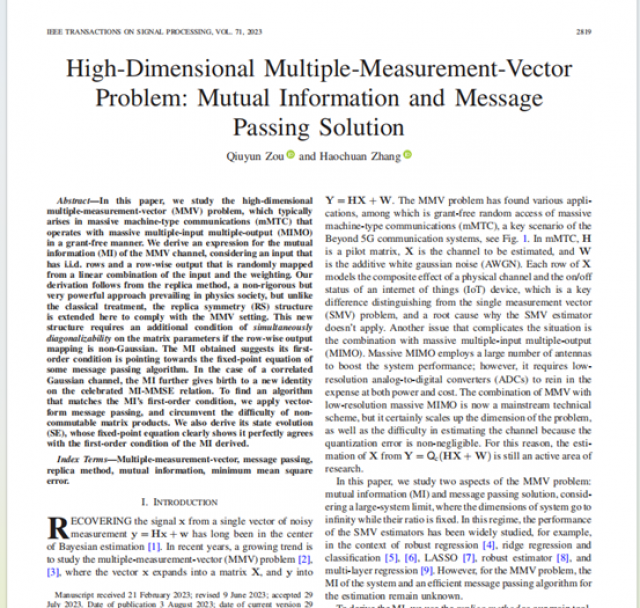
Recently, a young JUFE teacher, Dr. Zou Qiuyun, from the School of Finance published an article on IEEE Transactions on Signal Processing (TSP), a top-tier journal in the field of signal processing. The impact factor of this journal is 5.4, making it highly influential in the research community.
Dr. Zou's article mainly studied the MMV (Multiple Measurement Vector)problem in large-scale machine-type communication (mMTC). This problem has wide applications in communication systems, especially in dealing with massive multiple input multiple output (MIMO) scenarios. In the article, Mr. Zou derived the expression of mutual information (MI) for MMV channels, considering inputs with independent and identically distributed (i.i.d) rows and row-by-row outputs that are randomly mapped from input and weighted linear combinations.
During the derivation, Dr. Zou employed the replica method, a powerful non-rigorous approach commonly used in physics. However, unlike classical treatments, the replica symmetry (RS) structure was extended here to accommodate the MMV setting. If the row-by-row output mapping is non-Gaussian, this new structure requires an additional condition for simultaneous diagonalization of matrix parameters. The obtained MI shows that its first-order condition points to the fixed-point equation of a certain message-passing algorithm. In the case of Gaussian channels with correlation, Dr. Zou further derived new identities on the famous MI-mmse relationship. To find an algorithm matching the first-order condition of MI,he adopted vector-form message passing and circumvented the non-commutativity difficulty of matrix multiplication. She also derived the state evolution (SE) of this algorithm,whose fixed-point equation explicitly demonstrates its complete consistency with the derived first-order condition of MI.
Zou's research provides a deeper communication and offers a new perspective for the development of message-passing algorithms, which has important guiding significance for the future development of communication technology.

Jiangxi University of Finance and Economics
Contact us: Office of International Cooperation and Exchange(OICE)
Address: No.168, East Shuanggang Road, Nanchang, Jiangxi Province, PR. China 330013